Module 03 — Artificial Intelligence
Artificial Intelligence and Image Forensics
An image can be created entirely by an algorithm — no camera, no light, no real scene. The result looks like a photograph, but it is not. This module explains how artificial intelligence generates images, what technical traces that generation leaves, how the C2PA standard makes provenance verifiable, and what a forensic tool can — and cannot — assert about a suspicious image.
What is synthetic content?
Synthetic content is any file produced by artificial intelligence software without capturing the real world: no camera, no microphone, no physical scene. It can be an image, audio, video or text. The term "synthetic" distinguishes the creation process from the result: the appearance may be indistinguishable from a real photograph, but the origin is algorithmic.
The scale of the phenomenon is significant. Since AI generation models became widely available in 2022, industry estimates point to tens of billions of synthetic images created and circulating on social media, news platforms and messaging apps. For comparison, humanity took more than a century to produce the same volume with conventional cameras.
The main types of synthetic content with forensic impact are:
- Synthetic image: generated from a text prompt or another image by tools such as Midjourney, DALL-E, Adobe Firefly and Stable Diffusion. It looks like a photograph but records no real moment.
- Video deepfake: replacement or animation of faces in video, used to fabricate statements by real people.
- Voice cloning: audio synthesis that mimics someone's voice from short samples.
- Synthetic text: generated by language models such as ChatGPT. Technically harder to detect than image or audio.
For forensic work, what matters is not just knowing that synthetic content exists, but understanding what technical traces the generation leaves and how those traces can be verified in an objective and reproducible way.
How diffusion models generate images
Most synthetic images produced today are the result of diffusion models. Understanding the basic principle helps explain why generation leaves specific technical traces.
The process in three steps
During training, the model receives millions of real images to which random noise is progressively added until the image becomes pure noise. The model learns to reverse this process: starting from noise, it learns to remove noise in successive steps until something coherent emerges.
At generation time, the process is run in reverse: the model starts from random noise and applies dozens of denoising steps, guided by a text prompt that steers the image towards a target. The result is an image that never existed, built statistically from learned patterns.
Why synthetic images lack camera noise
Real photographs have sensor noise: random variation in pixels caused by the camera hardware, temperature and lighting. This noise has a statistical pattern specific to the sensor and is distributed non-uniformly across the image.
Synthetic images do not have camera noise. What they have is the statistical pattern of the diffusion process: a high-frequency texture distributed more homogeneously, one that does not correspond to any physical sensor. This difference is detectable through frequency analysis and is one of the technical markers used in forensic detection tools.
Known blind spots of current models
Generation models have documented limitations: hands with the wrong number of fingers, illegible text on surfaces, inconsistent reflections in glass and eyewear, shadows that contradict the declared light source, and anatomical inconsistencies at object edges. As models evolve, these blind spots narrow, which makes artefact-based visual markers progressively less reliable as a standalone criterion.
C2PA — the content provenance standard
C2PA (Coalition for Content Provenance and Authenticity) is an open provenance standard created in 2021 by Adobe, Microsoft, the BBC, Intel, Truepic and other organisations. Its aim is to embed directly in the file a cryptographically signed record of how that content was created or modified.
What a C2PA manifest is
A C2PA manifest is a block of metadata with a digital signature, embedded in the image file (JPEG, PNG, TIFF, and others) or video. It contains:
- Claim generator: identifies the software that created the content. A value of
Adobe_Fireflyindicates creation by Firefly, Adobe's generative AI tool. - AI asserted (aiAsserted): a boolean field that explicitly states whether the content was generated by artificial intelligence.
- Digital source type (digitalSourceType): an IPTC code that classifies the nature of the creation. The code
trainedAlgorithmicMediaindicates content generated entirely by a model trained on data, with no real-scene capture. - Signature validity (signatureValid): confirms that the manifest has not been tampered with since creation.
Why the signature matters
The manifest is signed with the generator's private key (Adobe's, in the case of Firefly). Verifying the signature proves that the manifest was not created or altered by a third party after generation. Modifying any field invalidates the signature, and that invalidation is detected automatically by C2PA-compatible tools.
Growing adoption
In 2024, OpenAI began including C2PA metadata in images generated by DALL-E 3. Google adopted the standard in Imagen. Adobe integrated C2PA across the Creative Cloud suite. Platforms including YouTube and LinkedIn announced support for reading manifests. This does not mean every AI-generated image will carry a manifest, but the absence of a manifest in a context where one would be expected is itself a relevant data point.
Limitations
C2PA does not address images generated before the standard was adopted, or from tools that have not yet implemented it. A synthetic image without a manifest cannot be identified through C2PA, and the absence of a manifest does not prove authenticity. The standard functions as positive evidence when present, not as negative proof when absent.
Real case — Adobe Firefly identified by MetaScope
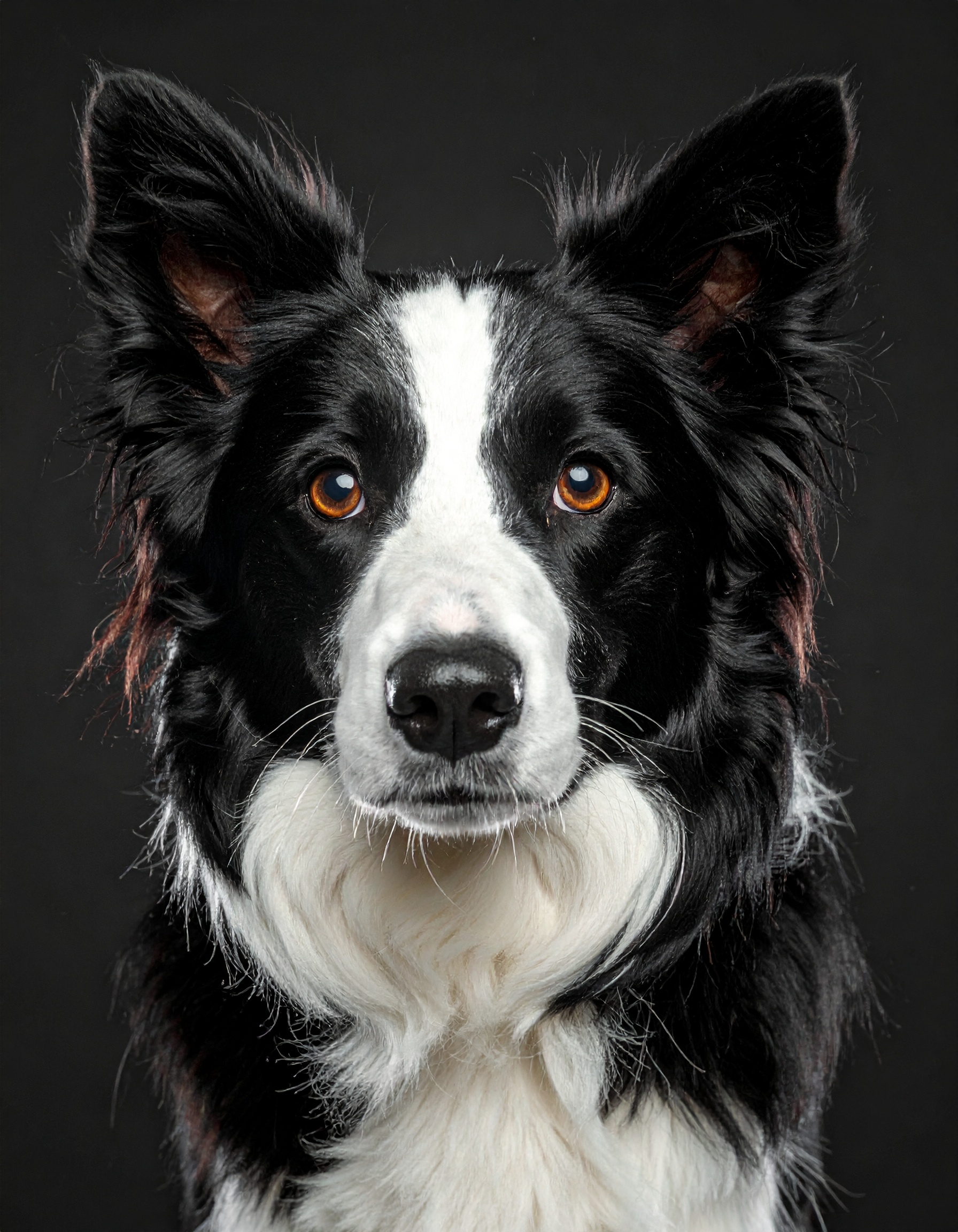
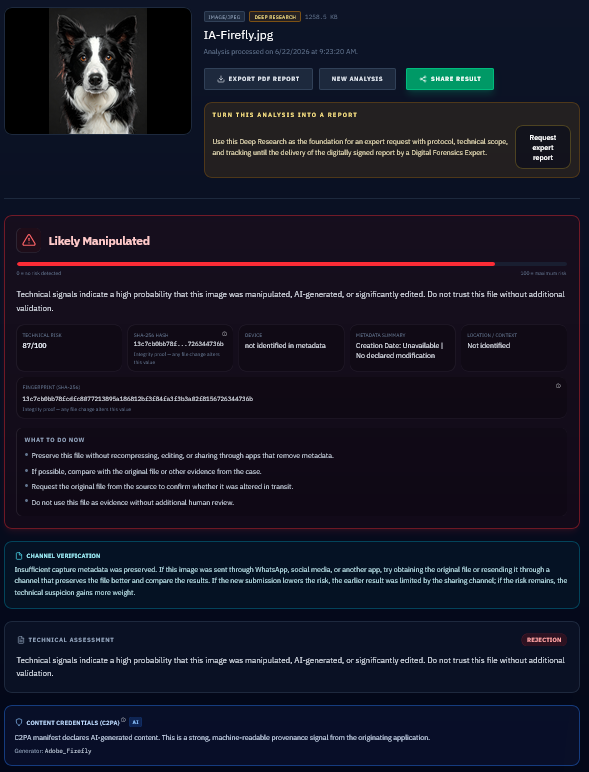
In a test using forensic samples, MetaScope analysed a JPEG image generated by Adobe Firefly. The file showed no obvious visual characteristics of artificial generation: consistent lighting, no hand or text distortions, the appearance of a professional photograph. Identification came exclusively from the C2PA metadata.
What the manifest contained
| C2PA field | Detected value |
|---|---|
| Manifest present | Yes |
| Signature valid | Yes |
| Claim generator | Adobe_Firefly |
| AI asserted | Yes |
| Digital source type | trainedAlgorithmicMedia |
What each field means in this case
- Manifest present: the file carries an embedded C2PA block, indicating it was produced by a tool that implements the standard.
- Signature valid: the cryptographic signature of the manifest is intact. The manifest was not modified after generation, confirming that the remaining fields are authentic and were not inserted manually by a third party.
- Claim generator
Adobe_Firefly: Adobe signs its manifests with its own corporate certificate. This field cannot be inserted by an ordinary user without invalidating the signature. - AI asserted
true: explicitly confirms that the content was generated by AI, consistent with the generator's own declaration. - Source type
trainedAlgorithmicMedia: IPTC code classifying the content as the product of a machine learning model, with no real-scene capture.
What this proves and what it does not
The combination of a present manifest, a valid signature and aiAsserted: true constitutes objective technical evidence that the image was generated by AI — specifically by Adobe Firefly. The valid signature guarantees that this record was not inserted by a third party after the fact. The result is reproducible: any C2PA-compatible tool, in any laboratory, will produce the same manifest reading.
Detection does not address the context of use: the image may have been generated for legitimate or deceptive purposes. The tool identifies the origin; the forensic interpretation of the use is the responsibility of the examiner.
ELA and statistical markers
When an image has no C2PA manifest, detection of artificial origin depends on indirect technical analysis. The main approaches are:
ELA — Error Level Analysis
ELA is a technique based on JPEG compression. When a JPEG image is saved, the compression algorithm introduces a specific pattern of quality loss in 8×8-pixel blocks. Re-saving the image modifies that pattern. Comparing the original with a re-compressed version reveals regions where the error level is inconsistent: blocks that were digitally manipulated or inserted from another source exhibit a different error pattern from the rest of the image.
In AI-generated images, ELA reveals a distribution of error levels that is more uniform and homogeneous than expected for a camera-captured scene. This pattern, in isolation, is not conclusive proof, but it is a relevant supporting marker.
Frequency analysis
Real photographs have a spatial-frequency distribution specific to the sensor and the camera's optics. Diffusion-generated images have a high-frequency pattern characteristic of the noise-to-image process. Applying the Fourier Transform (FFT) to an image reveals this difference as a spectral distribution inconsistent with real-scene capture.
Statistical inconsistencies
Diffusion models produce images with localised anomalies: edges that do not follow natural gradients, textures with slightly non-organic periodicity, eyes with reflections that contradict the scene's lighting. These patterns are analysed by classification models trained to distinguish synthetic from real content.
Limits of statistical markers
Statistical analysis produces probabilities, not certainties. A "suspicious" result means the patterns are more consistent with artificial generation than with camera capture, but does not exclude a heavily processed photograph or a legitimate composite. As generation models improve, some of these markers lose effectiveness.
A robust approach combines C2PA manifest inspection (when available), ELA, frequency analysis and multi-modal visual-language model analysis. MetaScope integrates all these layers in a single examination.
What AI detection proves in legal proceedings
The legal question is not technical: it is procedural. What an AI detection tool can assert, and with what probative weight, depends on the method, the documentation and the context.
C2PA manifest with valid signature
This is the strongest technical evidence currently available. The validity of the cryptographic signature can be verified by any compatible tool, regardless of who performs the verification. The result is reproducible: the same file, in any forensic laboratory, will produce the same manifest reading.
In proceedings, this can support the conclusion that the image was not captured by a camera, without reasonable technical doubt, provided the report describes the method and the chain of custody of the file.
Statistical markers
These constitute indirect evidence with lower probative weight. The correct language in an expert report is: "the statistical markers present are consistent with artificial generation and inconsistent with camera capture." Not: "the image is definitively fake."
The distinction matters because detection models have known false-positive rates, and the opposing party may challenge the reliability of the method in court. A report that does not state the error rate of the method and the confidence limits of the conclusion is technically vulnerable to challenge.
What no tool can prove
No current detection tool can establish, on its own, that an image was used with intent to deceive. Intent is a subjective element belonging to the legal analysis, not the technical one. A synthetic image may have been generated for legitimate purposes and used fraudulently by a third party. Technical detection identifies the origin; the narrative of how it was used belongs to the proceeding.
MetaScope as a triage tool
MetaScope does not replace an expert report. It provides documented technical triage: file hash, C2PA manifest when present, ELA analysis, visual-language model analysis and an integrity record. That package can be the starting point for a formal examination or an auxiliary element in a proceeding that does not require a specific expert report.
The full platform — with the forensic analysis modules for media, documents and links — is documented at [investigacaoforense.com/aplicacoes/metascope](https://www.investigacaoforense.com/aplicacoes/metascope).
Frequently asked questions
If an image has no C2PA manifest, is it authentic?
Not necessarily. The absence of a C2PA manifest means the file was not created by a tool that implements the standard, or that the manifest was removed. Images generated by older tools, by tools that have not yet adopted the standard, or that have been through editing processing may not carry a manifest. Absence opens the way for analysis by statistical markers but does not prove authenticity.
Can the C2PA manifest be removed from an image?
Yes. Saving the image in a different format, re-compressing it, screenshotting it, or uploading it to platforms that strip metadata all eliminate the manifest. This is why C2PA is positive evidence when present, but its absence is inconclusive regarding origin. Organisations committed to content provenance are developing ways to preserve the manifest even after re-compression.
Can an AI-generated image be used as documentary evidence in proceedings?
It depends on context. A synthetic image presented as a real photograph of a specific event constitutes tampered evidence. The same image used as a declared illustration does not. The forensic question is always: was the image presented as a faithful representation of a real fact? If so, and if its synthetic origin is proved, the use is fraudulent.
Does MetaScope detect deepfakes in video?
Yes, partially. MetaScope's video analysis examines inconsistencies across static frames, compression patterns and artificial-generation markers visible in visual-language model analysis. High-quality deepfakes produced with specialised tools require more in-depth forensic analysis than automated triage can reliably provide. MetaScope's video result is indicative, not conclusive in isolation.